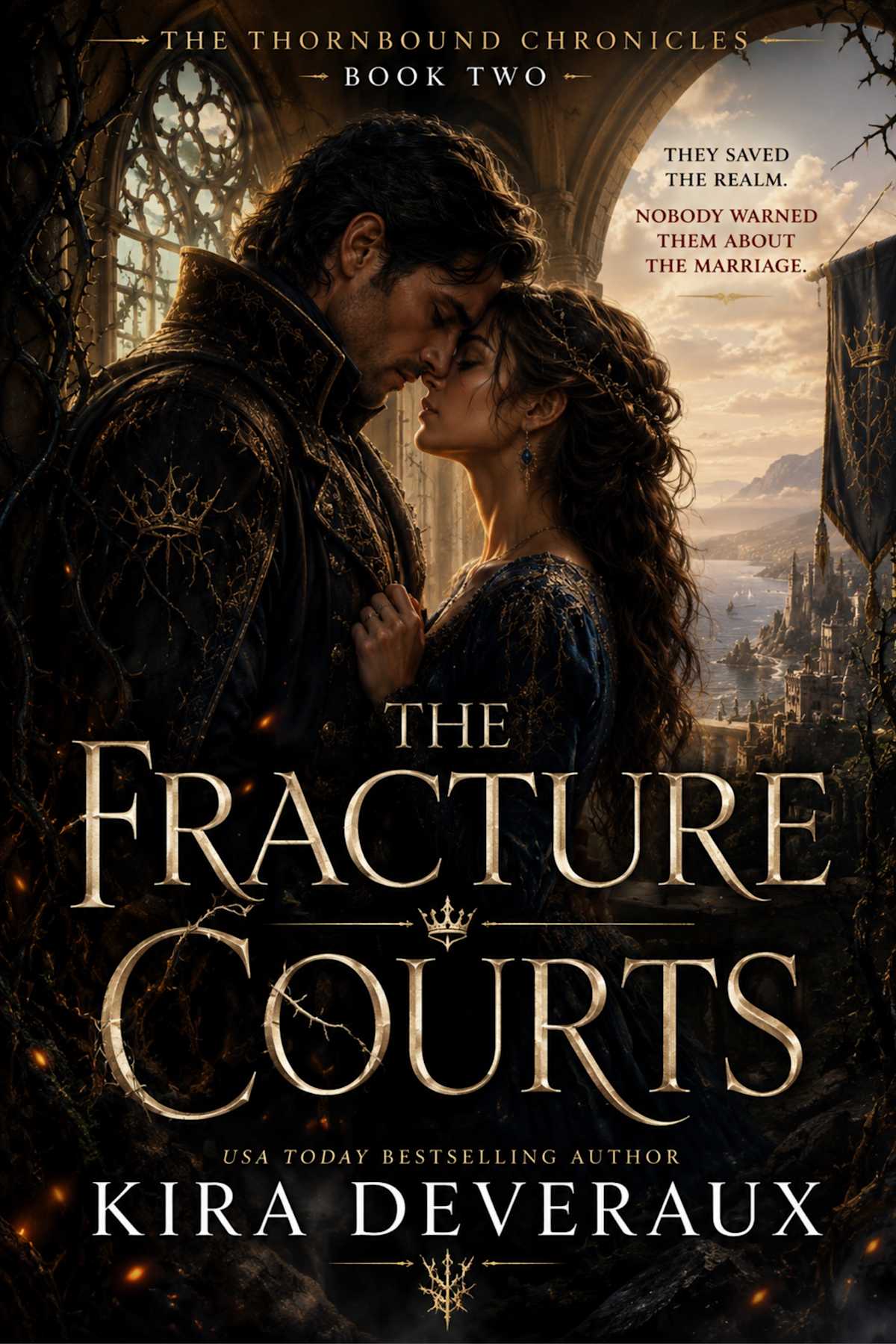
THE CROSSROADS
A free companion scene to THE FRACTURE COURTS (The Thornbound Chronicles) · Kira Deveraux
Aric’s POV. The day Coll Bray drove a furious seventeen-year-old to the edge of the border with a winter coat and seven words — and the morning, eleven years later, the words finally land. Bring something to wipe your eyes with.
There is a chair in the council chamber that no one sits in.
They draped it the day after they pulled Coll Bray out of the Greywood mud, a length of grey wool over the back and arms, and they have left it draped through every session since, because the chamber is new and superstitious and has decided that a seat can keep a place the way a lighthouse keeps a bearing. I am Warden-Commander of the Eastern March now. I command the Thornwake, who used to be outlaws and are now sworn, and I wear a seal with a thorn on it that has one barb because I drew it myself and could not in conscience give myself two. I am, by every measure the realm keeps, a man who arrived. And I cannot walk past that draped chair without my throat doing the thing throats do, because eleven years ago Coll Bray put a winter coat over my shoulders the same way they’ve put that wool over his seat, and said seven words, and I spent eleven years not hearing them.
I hear them now. That’s the cruelty of arriving. You finally understand the people who pointed you here, exactly when the road has carried you past the place where you could turn and thank them.
Let me tell it the way it happened, because Bray would want it told plain, the way he wanted everything: plain, and a beat too late to do you any good, and true.
I am seventeen. I am the angriest creature the border has ever produced, and the border produces angry creatures the way the coast produces salt, in bulk, as a condition of the air.
My mother is Sela Voss. You will have heard the name; everyone has, now, since the council seats, since the amnesty hearings, since she became the thing the chamber stands up for. Eleven years ago the name meant something narrower in our house, and the narrow thing was she negotiates with them. The empire seizes a grain store, and Sela Voss does not burn the garrison; Sela Voss opens a ledger and finds out which captain can be made to look away, and trades, and saves nine villages by being on speaking terms with the men who starve the tenth. I was seventeen, and I had a brother’s worth of grief in me for a tenth village, and I called my mother a collaborator to her face, in the kitchen, with the door open so the whole lane could hear me do it.
She did not slap me. I wanted her to. A slap I could have left on. A slap is a door. She just looked at me with the tiredness she’d earned and said, “All right, Aric,” which is the most devastating thing a person can say to a boy who has come for a fight, and I packed a bag and went to stand at the crossroads on the Calder road to wait for any cart going anywhere that wasn’t her.
Coll Bray’s was the cart that came.
He was border council before there was a border council — a big slow man who ran salt and grain and gossip up and down the coast road and knew everyone’s business because everyone told him, because there was something in the slowness of him that made you set your load down. He stopped the cart. He looked at me, and the bag, and the open kitchen door three houses back with my mother not standing in it, and he understood the whole of it the way he understood everything, by being too unhurried to miss it.
“Climb up,” he said.
“I’m not going where you’re going.”
“Nobody is, son. That’s why it’s the border.” He moved a sack of meal to make room. “Climb up. I’ll take you to the edge of the wards and you can be furious somewhere with a view.”
The ride is twenty minutes. I have measured it since, on horseback, on foot, with an army; it is twenty minutes from our lane to the last ward-anchor before the wild coast, and Coll Bray used every one of them, and not the way I expected.
I expected a lecture. I was braced to be told my mother was a hero, that I was a child, that the world was complicated — all the sentences adults deploy to make a boy’s clean rage feel stupid. He didn’t say any of them. He let me be furious for nineteen of the twenty minutes. He drove, and chewed something, and let the silence be mine to fill, and I filled it: with the tenth village, with the captain my mother shook hands with, with the word collaborator I’d practiced for a year and finally spent. He listened to all of it the way you listen to weather, without flinching and without agreeing, and somewhere in it the fury started to run out the way fury does when nobody fights it, leaving the cold thing underneath, which was not anger at all. Which was that I was seventeen and leaving my mother and I did not know how to do either.
At the last anchor he stopped the cart. The wards end there in a way you can feel — a thinning, the hum going out of the air, the wild coast opening past it grey and enormous and uninterested in any of us. He reached behind the seat and took out a coat. A good one. Wool, oiled, a man’s coat, too big for me, the kind you grow into over the exact number of years it takes to stop being a furious boy.
“It’s not winter,” I said.
“It will be,” said Coll Bray, “wherever you’re going. It always is, the first year out. Take the coat.”
He put it over my shoulders himself. I let him, because I was seventeen and too proud to put it on and too cold to refuse it, and that is the precise size of the mercy he was offering: a thing I could accept without having to admit I needed it.
And then he said the seven words.
He did not say them as wisdom. That’s what took me eleven years — I kept the words but lost the delivery, and the delivery was the whole of it. He didn’t say them like a man handing down a truth. He said them like a man reporting a fact he was sorry about, looking at the wild coast and not at me, in the flat tone you use for the things that are too true to dress up.
“She stayed so you could leave angry,” Coll Bray said.
Then he clicked to the horse and turned the cart and went back up the Calder road to a life of running salt and saving the ninth village, and left me at the edge of the wards in a coat too big for me, furious, free, and eleven years from understanding a single word he’d said.
I thought it was a defense of her. That’s why I didn’t hear it. I was seventeen and armored and I took she stayed so you could leave angry to mean your mother is good, actually, so stop — one more adult telling me my rage was childish, and I had a whole bag packed against exactly that sentence, so I threw it in the bag with everything else and carried it eleven years and never once opened it.
Here is what it actually meant. I know now because I have done the thing, finally, that lets a man hear it: I have stayed.
I have stood on a seawall with the cold coming off the eastern water and held a coast I wanted to abandon, because abandoning it would have been cleaner and someone has to do the unclean thing or the whole March goes dark. I have shaken hands with men I’d rather have hit, and traded with envoys I’d rather have drowned, and chosen the ninth village over the satisfaction of burning the captain who took the tenth — I have become, God help me, exactly the thing I called my mother in a kitchen with the door open, and I have learned what it costs, and what it costs is this: you give up the right to be clean so that someone you love gets to keep theirs.
She stayed so I could leave angry. She took the dirty arithmetic — the captain, the ledger, the speaking terms with starvation — onto herself, so that I could grow up believing the world had a clean version, and rage at her for not living in it, and walk away into a coat too big for me with my fury intact and unspent and mine. My anger was a thing she paid for. She ran the compromise so that her son could afford to refuse it. The collaboration I despised her for was the price of my being allowed to despise it. She stayed in the mud so I could leave standing.
And Coll Bray saw it, eleven years ago, in nineteen minutes of listening to a boy mistake his mother’s sacrifice for her sin, and he could not fix it, because some things won’t land until the road has carried you far enough to look back and see the shape of them — so he didn’t try. He just gave me a coat and the seven words and the twenty minutes, and trusted the road to do the rest, the way you log a bearing and ring the bell and let the ship find its own way in.
The ship found its way in. It took eleven years. Coll Bray did not live to see it dock.
I went to the draped chair this morning before the chamber filled.
I am not a man who talks to furniture. The Thornwake would mutiny if they saw it. But the chamber was empty and the wool was grey on the arms the way the coat was grey on my shoulders, and I stood in front of Coll Bray’s kept place and I said the thing I had carried eleven years and finally understood, plain, the way he’d want it.
“I heard you,” I told the chair. “It took me the whole road. She stayed so I could leave angry. I know what it cost her now, because I’ve paid it, and I’d have paid it sooner if I’d had the sense to hear you at the crossroads instead of the seal on my own coat.” My throat did the thing. I let it. “You gave a furious boy a coat he could grow into and seven words he couldn’t, and you were right about both. I grew into the coat about four winters ago. The words this morning.”
Sela came in then — my mother, the council’s standing ovation, the woman I left in a kitchen — and saw me at the chair, and understood, the way Bray understood, by being too unhurried to miss it.
She did not say I forgive you, because there is nothing to forgive a son for paying you the compliment of believing the world was clean. She did not say I’m proud of you, which would have been a slap, a door, a thing I could leave on.
She just came and stood beside me at Coll Bray’s kept place, the two of us looking at a chair no one will sit in, and after a while she put a coat over my shoulders — the same coat, eleven years older, oiled and grey and finally the right size — because she had kept it, she had kept it the whole time, and she said, in the flat tone you use for the things too true to dress up:
“It’s winter on the coast, Warden-Commander. Take the coat.”
I took the coat.
I’d had the sense, this time, to need it out loud.
Coll Bray gets the realm a border council and the worst possible exit line. Aric gets his mother back one nod at a time. It’s all in The Fracture Courts. And the eastern water is rising — The Shatterfield* is coming. Sign up at www.kiradeveraux.com/bonus, and bring something to wipe your eyes with.*