THE SEVERANCE CIRCLE
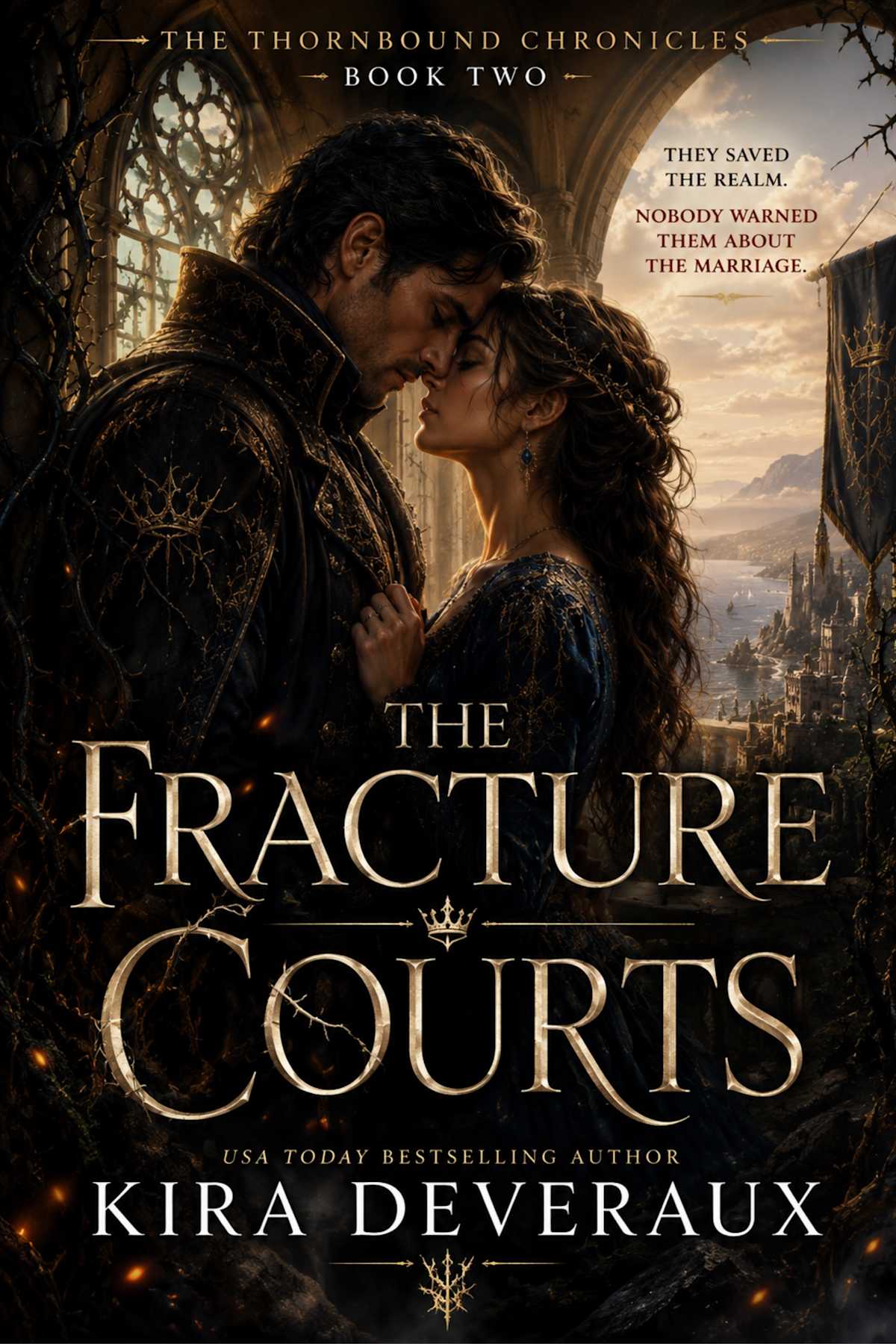
A free companion scene to THE FRACTURE COURTS (The Thornbound Chronicles) · Kira Deveraux
Caelan’s POV — the night of the chalk, from the events of Thornbound Crown, Chapter Twenty. The bond is still compelled here. Nothing between them is chosen yet. This is the night that changes.
She draws the circle in chalk on the vault floor, and I stand at the edge of the lamplight and let her believe I am calm.
This is the one thing no one has ever caught me at, in twenty-five years of being watched for the place where a Draven might crack: I can hold a face the way other men hold a line. Arms crossed. Jaw that gives nothing. A stillness that reads, to a room, as a man deciding, when in fact it is a man who decided long ago and has only learned to keep the deciding off his skin. My father taught me the stillness without meaning to, by being the thing it was built to survive. I have worn it through a coronation that didn’t happen and a war that did and the reading of a ledger with forty-three names on it that I make myself say slowly, once a month, because saying them quickly is how you become a man who can seize a grain store and sleep.
I wear it now. She kneels on the cold stone with a nub of chalk and draws the rite that will cut me loose from her, and I keep my arms crossed and my face shut, and inside the shut face I am doing the only undignified thing I have done in years, which is to beg, silently, in a language I would die before speaking aloud: don’t finish the line.
“The geometry has to close,” Elowen says, not looking up. “Orin found it in the pre-Fracture hand. A severance isn’t a cut. It’s a returning. You give the bond back the shape it had before two people were threaded into it, and it lets go, because there’s nothing left for it to hold.” The chalk turns the last corner. “It will hurt. Both of us. Then it won’t hurt at all, ever again, and that’s the part that’s supposed to sound like mercy.”
“And the ward network.”
“Goes unstable for a season. Maybe two. The lattice was anchored to the bond when Merrick staged the Rite; pull the bond and the anchors flutter.” She sits back on her heels. Thorn-marks have surfaced along her forearms the way they do when she is holding a feeling at the threshold instead of letting it through — fine green tracery, the body telling the truth the mouth won’t. “Villages on the outer ring will run cold for a while. People will be hungry who weren’t. I’ve counted it. It’s a price I can pay, because the alternative is worse.”
“What’s the alternative.”
She looks up at me then, and the lamplight finds the exhaustion she hides as well as I hide everything, and she says the sentence that is the reason I am standing in a freezing vault at the hour the towers go quiet, watching a woman draw a door I do not want her to open.
“The alternative is that I keep wanting you,” she says, “and never once know if it’s mine.”
I should explain what the bond is, because she is right that it is the whole horror of us, and because no one outside the two of us has ever understood it and I have given up trying to make them.
It is a relay. Grief, fear, adrenaline — the loud feelings, the ones that don’t ask permission — they cross. When the garrison burned at the border and I felt her terror arrive in my own chest two heartbeats before the runner did, that was the bond. When I grieve the forty-three and feel, faintly, a grief running back the other way that is hers borrowing mine, that is the bond. It does not make us love each other. It is cruder than that and far worse: it makes us feel each other, constantly, without consent, so that neither of us can ever be sure where our own heart ends and the compelled echo of the other one begins.
She cannot tell whether she wants me or only feels the wanting bleed through the thread. And because she cannot tell, she will not have it. That is the entire architecture of Elowen Vale, the thing I understood about her before I understood anything else: she would rather cut out the best thing in her life with a chalk line and a winter of hungry villages than hold something she isn’t certain she chose. She inherited a resistance network and a dead father’s guilt and a magic that surfaces when she lies to herself, and out of all of it she built one law: nothing compelled is allowed to count.
It is the most honorable thing I have ever encountered. It is going to take from me the only thing I have ever wanted without being told to want it. Both of those are true, and I keep my arms crossed, and I say nothing, because the stillness is the only dignity I have left and I am not ready to spend it.
“You’re very quiet,” she says.
“You’re about to perform surgery on the inside of my chest. I’m letting you concentrate.”
It earns the thing I built it to earn — the corner of her mouth, the almost. She catches it and puts it away, the way she puts everything away, and I add it to the small private ledger I keep of every time I have made Elowen Vale nearly smile, a ledger I will lose tonight along with everything else the thread carries, because a severance is a returning, and what it returns me to is a man who never felt her at all.
That is the part I have not said. That is the part the stillness is hiding.
I do not want to stop feeling her.
“Stand in the circle,” she says. “Both feet. It won’t work if you’re at the edge with your arms crossed deciding whether to allow it.” A beat. “I know that’s your whole posture. I’m asking you to drop it for the length of one rite.”
I uncross my arms. I see her notice. We have spent a war learning to read the smallest tells on each other across a room, and she clocks the arms coming down the way I would clock a flag changing on a far wall, and something moves through the thread that I cannot name and that she, I think, cannot name either, and that is exactly the problem we are here to solve and exactly the reason I no longer want it solved.
I step into the circle.
“Last thing,” she says, kneeling at the chalk’s edge with her hands flat on the cold floor, and her voice has gone careful in the way that means she is about to be braver than she can afford. “When the geometry closes, the relay opens all the way for a moment first. One breath, both of us, nothing withheld. It’s how the rite finds the threads to cut — it has to see them lit. So you’ll feel the whole of me, once, with no wall, and I’ll feel the whole of you, and then it ends, and we’ll never feel anything across it again because there won’t be an across. I wanted you to know. So it doesn’t frighten you when it comes.”
“It won’t frighten me,” I say, and for once the stillness is not a lie. I am not afraid of feeling the whole of her. I have wanted exactly that, with no wall, since before I had the courage to want anything.
She draws the breath. She closes the line.
And the relay opens all the way.
I have no language adequate to it, and I am a man who was raised to have language adequate to everything, so understand what it costs me to say: there are no words. For one breath the wall between us is simply gone, and I feel the whole of Elowen Vale, undefended, and it is not what I expected, because I expected to find her wanting me and instead I find her terrified of wanting me — I find a woman who has built her entire self on the proposition that she is not allowed to be chosen, only used, that everyone who has ever loved her did it because they needed a martyr or a symbol or a key, and that to want this, to want a prince’s hands and a quiet morning and a thing that is only hers, would be the one selfishness her father’s death has forbidden her forever. I feel her loneliness, which is the size of a country. I feel, underneath it, threaded so deep she has never once let it surface, the thing she came here to cut out so she’d never have to know if it was real.
It is real. I can feel that it is real. She is the only one who can’t.
And she feels me. I let her. I drop the stillness, all of it, for the length of one breath I will never get back, and I let Elowen Vale feel the whole of what twenty-five years of held faces was hiding: that I do not want to be cut free; that the bond is the first thing in my life I did not choose and am glad I did not choose, because it gave me her before my discipline could talk me out of it; that I have spent the war terrified of becoming my father and that she is the only evidence I have ever had that I might not; that now it’s only us is a sentence I have started saying to her in my head, in the east gallery, in council, in the dark, and that I would burn the crown before I’d let a chalk line take it back.
For one breath, she has all of it. No wall. Nothing withheld.
Then the geometry reaches for the threads.
And she stops.
She lifts her hand off the floor before the rite can take. The chalk line breaks where her palm smears it, one clean gap in a circle that needed to close, and the relay slams back down to its ordinary cruelty, the wall returning, the two of us thrown back into our separate uncertain chests — but not before. Not before the breath. We both felt the breath. There is no unfeeling it now.
She is staring at the broken line like it betrayed her. Her thorn-marks are blazing the whole length of both arms.
“I felt you,” she says. Her voice is not steady. I have never heard it not steady. “I felt — you don’t want it cut.”
“No.”
“You let me feel that. On purpose. You knew the breath was coming and you opened all the way instead of guarding, so I’d have to —” She stops. Her hand is still pressed to the broken chalk, the gap she made, the surgery she could not finish. “That’s cheating. That’s the most underhanded thing anyone has ever done to me. You used the one honest moment the rite allows to campaign.”
“Yes,” I say.
“Why.”
And here is the thing the stillness was hiding, the thing I have not said in this vault or anywhere, the thing I finally say because she felt it anyway and there is no posture left worth keeping:
“Because you’d cut out the best thing in your life rather than hold a thing you weren’t sure you chose,” I say. “And I couldn’t stop you with an argument; you’d already counted the villages. So I stopped you with the truth. I can’t make you trust that what you feel is yours. I’m not asking you to cut the bond to find out. I’m asking you to leave it, compelled and uncertain and unbearable, and stand inside the not-knowing with me, on purpose, until the staying gets long enough that it stops mattering whether it started as a choice — because by then it will be one. That’s all I have, Elowen. Not certainty. The willingness to keep choosing it before either of us is sure. The harder entry. Every page, the whole way down.”
She does not answer for a long time. The lamp gutters. Somewhere above us a tower runs uneven, an anchor fluttering on a network that almost lost its mooring tonight and didn’t, because a woman lifted her hand.
“You broke the circle,” I say, when I can’t bear the quiet. “Not me. Your hand. I want that on the record. The Crown can ask whose choice it was, and the answer will be yours.”
“Don’t,” she says, “tell me what my own hand did.”
But she leaves the broken line where it is. She does not redraw it. She kneels in the wreck of a severance she chose not to finish, with the whole of me still ringing in her from one undefended breath, and after a while she says, very low, to the chalk and not to me:
“If I’m going to keep wanting you without knowing if it’s mine — then you have to do something for me.”
“Anything.”
“You have to stop hiding it.” She looks up. The marks are fading now, the truth let through and so no longer surfacing. “All of it. The face. The arms. I can’t stand inside the not-knowing with a man who keeps his half of it behind a wall. If I don’t get certainty, I get transparency. That’s the price. You felt everything of me tonight whether I wanted you to or not. From now on I get everything of you, on purpose. No stillness. No deciding where I can’t see. You said you’d choose it before you were sure. Then choose it out loud, every time, so I never have to wonder which Caelan I married — the one who feels it or the one who’s managing me into thinking he does.”
“We’re not married,” I say.
“We will be,” says Elowen Vale, to a broken chalk circle, on the cold floor of a vault, on the night she did not cut the bond, and it is the first time either of us has said it, and neither of us takes it back.
I uncross my arms. I had crossed them again without noticing — the old posture, the survived-father, the held line. I uncross them, and I keep them uncrossed, and it is the hardest thing I do that whole long war, harder than the battles, harder than the forty-three: I let her watch my face do the thing it wants to do, with no wall, on purpose.
She watches.
“There he is,” she says.
Want the rest of how these two learned to stop hiding from each other? It’s the whole of The Fracture Courts. And the realm beyond the eastern water is coming, in The Shatterfield. Sign up at www.kiradeveraux.com/bonus.